
Starting a business when you have zero prior experience or fancy professional skills can feel completely overwhelming. You might look at successful entrepreneurs and assume they were born knowing how to manage clients, market their services, and build websites. The truth is, almost everyone starts from scratch. If you are looking for realistic service business ideas for absolute beginners, you are in the right place. You do not need a business degree, a massive budget, or ten years of corporate experience to get started. You just need to know how to leverage everyday skills and solve simple problems for people who are willing to pay for your time and effort.
In this guide, we are going to break down the exact process of choosing a service business, validating your idea, and landing your very first client without feeling like an imposter. Let us dive in and build your confidence from the ground up.
1. Shift Your Mindset: Skills vs. Everyday Competence
The biggest mental roadblock for beginners is the belief that you must be a world-class expert to charge money for a service. This is a myth. In the service industry, you do not need to be the absolute best in the world; you only need to be a few steps ahead of the person hiring you, or simply willing to do a task that they hate doing themselves.
Think about the things you already do easily that others might find tedious or frustrating. Can you organize digital files? Are you great at responding to emails quickly and politely? Do you know how to edit short videos for social media using free smartphone apps? Do you enjoy walking dogs or house-sitting? These are all foundations for viable service businesses. When brainstorming service business ideas for absolute beginners, remember that convenience and reliability are often much more valuable to a busy client than elite technical wizardry.
Make a quick list of tasks your friends or family members always ask you to help with. Even if it feels too simple to you, if someone is willing to trade their hard-earned cash to save their own time, you have a legitimate business opportunity.
2. Brainstorming Low-Barrier Service Business Ideas
To keep things realistic and stress-free, your first business should require very little overhead, no physical inventory, and skills you can learn within a weekend. Let us look at three categories of service businesses that are exceptionally friendly to complete beginners.
First, consider administrative and virtual support. Many small business owners, local contractors, and busy professionals are drowning in day-to-day tasks like data entry, customer support email management, and scheduling appointments. If you can type reasonably fast and communicate clearly, you can become a virtual assistant.
Second, look at digital content assistance. Businesses know they need to be active on social media platforms like TikTok, Instagram, and Facebook, but they rarely have the time to create content. If you are comfortable scrolling through social media, you can easily learn how to clip long videos into short-form content, design basic graphics on free platforms like Canva, or write engaging captions.
Third, do not overlook local, hands-on services. Pet sitting, mobile car detailing, yard cleanup, and home organization are classic service business ideas for absolute beginners that require zero digital marketing complexity. You simply show up, do a great job, and let word-of-mouth do the rest.
3. Validating Your Idea Before You Spend a Dime
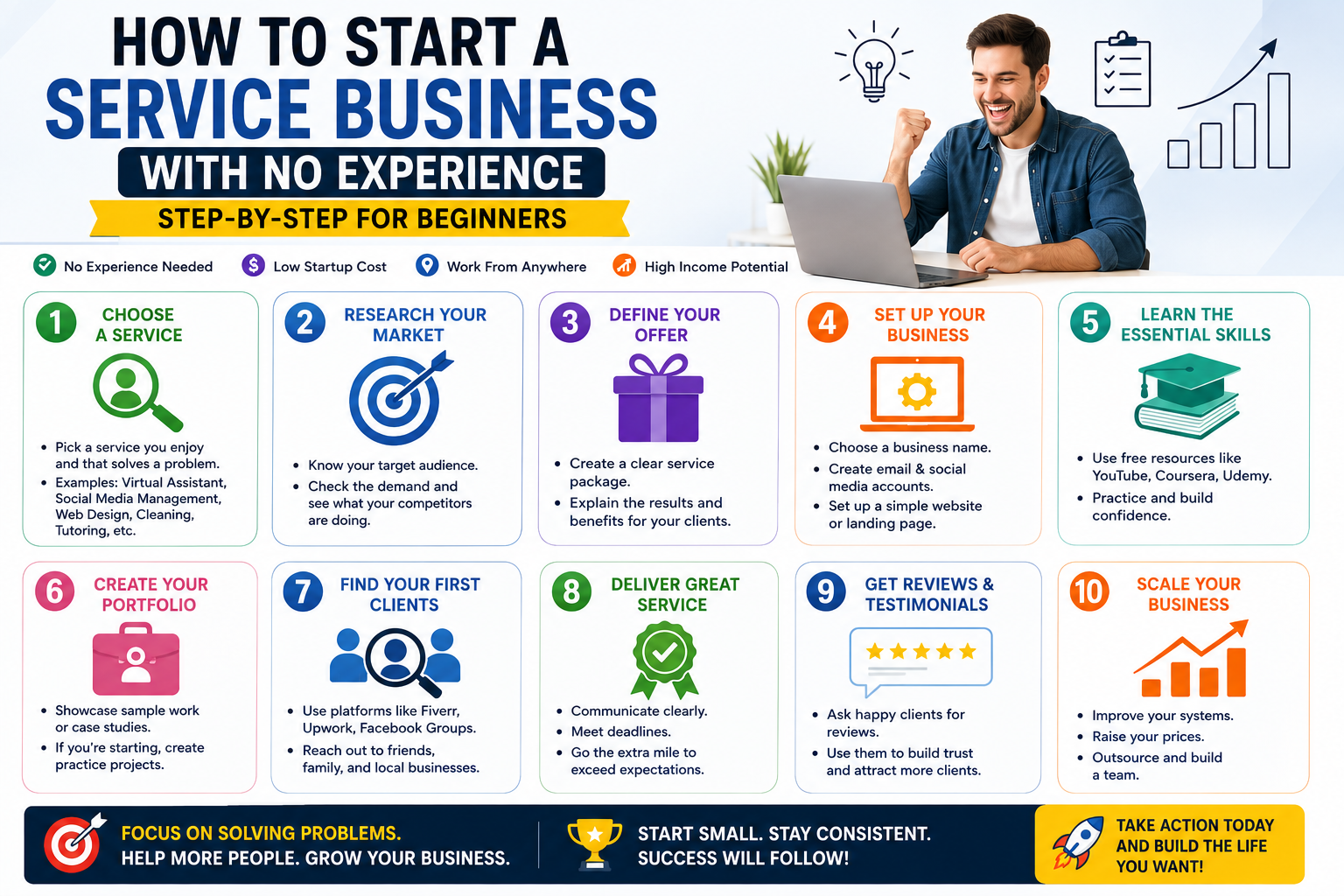
Once you have a rough idea of what you want to offer, the next step is making sure people actually want to buy it. Too many beginners spend weeks designing logos, building complex websites, and picking out business colors before ever talking to a single potential customer. Do not fall into this trap.
Validation simply means finding out if there is a real market demand for your chosen service. How do you do this? Look at where your target customers already spend time online or in your community. If you want to offer virtual assistance, look at Facebook groups for entrepreneurs or local business forums. See what people are complaining about. Are they struggling to keep up with customer emails? Are they posting jobs for basic admin help?
You can also run a low-stakes test. Offer your service to your first client at a heavily discounted rate—or even for free—in exchange for a detailed, honest testimonial. This takes all the pressure off you as a beginner, builds your confidence, and gives you crucial social proof that you can use to attract paying clients later on. Real-world feedback is infinitely more valuable than guessing in a vacuum.
4. Structuring Your Offer and Setting Your Prices
When you are just starting out, keep your service packages as simple as possible. Resist the urge to create a menu with twenty different options. Instead, create one clear, irresistible offer that solves a specific pain point.
For example, instead of saying, “I do social media management and graphic design and administrative work,” try saying, “I will design and schedule 12 social media posts for your local bakery every month so you can focus on baking.” Specificity sells.
When it comes to pricing, beginners often make the mistake of charging too little out of fear, or pricing themselves out of the market by guessing high. A great strategy for your very first clients is flat-rate project pricing rather than hourly pricing. Charging an hourly rate can make clients anxious about how long you are taking, especially if you are working a bit slower as you learn the ropes. A flat rate gives the client certainty: they pay X amount, and they get Y result. As you gain speed and confidence, you can gradually raise your rates to match the value you provide.
This post contains an affiliate link. If you sign up through it, I may earn a commission at no extra cost to you.
5. Getting Step-by-Step Guidance to Build Your Business
Choosing an idea and pricing it is a fantastic start, but sooner or later you will find yourself wondering about the practical mechanics: How do I legally set up my business? Where do I find my very first paying customer outside of my immediate circle? How do I build a simple, professional web presence without coding knowledge?
When you reach the stage where you want a clear, step-by-step roadmap to take you from a total beginner to launching your business, having a structured training platform makes all the difference. For comprehensive, beginner-friendly training on setting up an online presence and finding clients, check out Wealthy Affiliate. It walks you through the foundational tech steps, website setup, and traffic-generation strategies in plain English, which is ideal if you are starting with zero prior technical background.
6. Landing Your First Client and Managing Expectations
Getting your first client is a milestone worth celebrating, but it also requires the right mindset. Communication is your best tool here. Because you are a beginner, transparency is key. You do not need to lie about your experience level, but you do need to emphasize your dedication, your work ethic, and your commitment to making their life easier.
Reach out to your warm network first—friends, former colleagues, acquaintances, and local business owners you already patronize. Let them know what you are doing. Most people love supporting someone who is working hard to start a new venture. Send a friendly message explaining the service you offer and ask if they know anyone who might need help with it, or if they themselves could use some support that week.
Once you land that client, over-deliver. Show up on time, communicate clearly, ask clarifying questions if you are unsure about something, and deliver your work a little bit early whenever possible. Exceptional customer service in the beginning stages will generate referrals, and referrals are the lifeblood of a sustainable service business.
Conclusion: Take the First Small Step Today
Starting a service business with no experience is not about having all the answers on day one; it is about being willing to learn as you go. By picking a simple service, validating that people want it, keeping your offers clear, and focusing heavily on doing a great job for your very first client, you can build a real business from scratch.
Remember that every successful business owner started right where you are standing now—looking at a blank slate with a mix of excitement and uncertainty. Choose one small action from this guide today, whether it is writing down your list of everyday skills or telling a friend about your new business idea. Your entrepreneurial journey starts with that single step.
